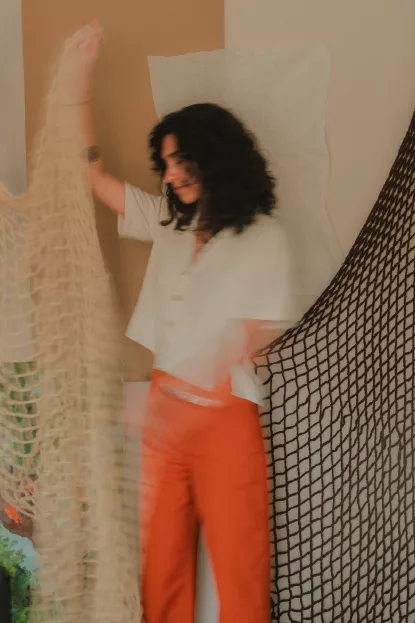
Irene Trapote proposes a collective and participatory initiative that invites us to rethink our relationship with the land through collaborative action.
The piece takes its starting point from the Asturian landscape, characterised by the interplay between sea and mountains, to foster a shared experience with the residents of the three towns where the project will take place. Through various physical networks, inspired by fishing nets and other forms of collective weaving, the artist will construct a poetic and participatory installation in which every gesture, every knot and every intersection will function as a metaphor for a community that reflects on itself.
Rather than taking an individual view of the territory, the project proposes to examine the ways in which a community organises itself, recognises itself and constructs memory through its everyday connections. The nets will appear as material, symbol and tool: surfaces that unite, sustain, gather and connect different ways of inhabiting the same landscape.
Through collaborative activities, the artist will create a space for us to ask ourselves how we inhabit a place, how others inhabit it, and how we might weave together a shared existence. A site-specific performance that brings together body, landscape and community, understanding the territory not only as a physical space, but as a living network of shared affections, knowledge and experiences.
This performance can be enjoyed on 25, 26 and 27 September at the various venues featured in the ‘Arte en las Plazas’ programme:
- CANDÁS – Friday 25 September, from 7 pm to 8.30 pm
- PRAVIA – Saturday 26 September, from 12.30 pm to 2 pm
- CANGAS DE ONÍS – Sunday 27 September, from 12.30 pm to 2 pm
ABOUT THE ARTIST
Irene Trapote (Gijón, 1998) is an interdisciplinary artist. She holds a Bachelor’s degree in Fine Arts and a Master’s degree in Art and Creation Research from the Complutense University of Madrid.
Her practice lies at the intersection of territory, the body and ecology, exploring the relationships between culture, the environment and memory from an ecofeminist perspective. She works with audiovisual media, textiles and collaborative practices, developing site-specific projects that address the eco-social crisis and the construction of community knowledge.
Her work proposes forms of listening and shared action, focusing on the connections between bodies, the landscapes they inhabit and the memories that run through them.