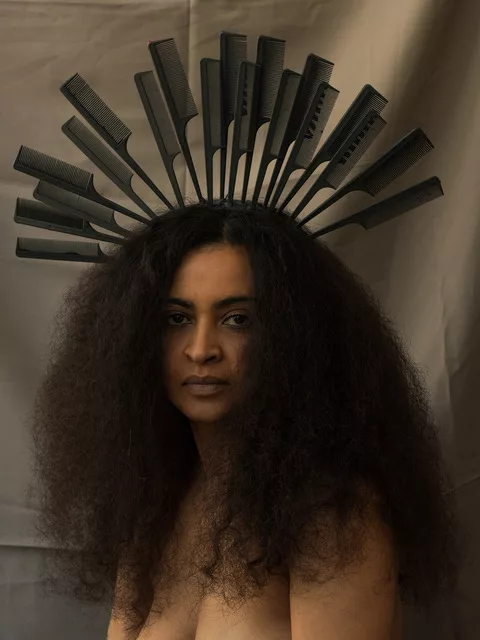
Photographic installation using the platinum print process on Hahnemühle Platinum Rag paper, and audiovisual work
–
Pixaim, by Claudia Prechedes, explores the boundaries of photography in various ways—whether through self-portraiture or by using the platinum print technique to capture her image.
By posing in front of a lens (a tool used for decades to control, classify, and categorize bodies in documentary work), Prechedes challenges this logic. Through her own agency, she reclaims the freedom of the Black body to choose to be photographed.
Documentary photography has historically been tied to state archives and scientific research, turning Black bodies into objects of study. These archives fueled eugenic theories that denied the humanity of African peoples and their descendants, reinforcing social stigmas that also saturated the art world. One example is Kodak’s Shirley cards, widely used to standardize color printing based on a white benchmark—a process that failed when applied to Black bodies.
In doing so, Prechedes’s works transform the tonal gradation of Black bodies into subjective power. She shifts photography away from its documentary roots and embeds it within contemporary art, claiming Black presence as an aesthetic and political marker.
Mayã Fernandes, art critic, curator, and historian
Salvador (Brazil), 2026
–
Artwork included in the exhibition “Interdependencias”, official section of PHotoESPAÑA.