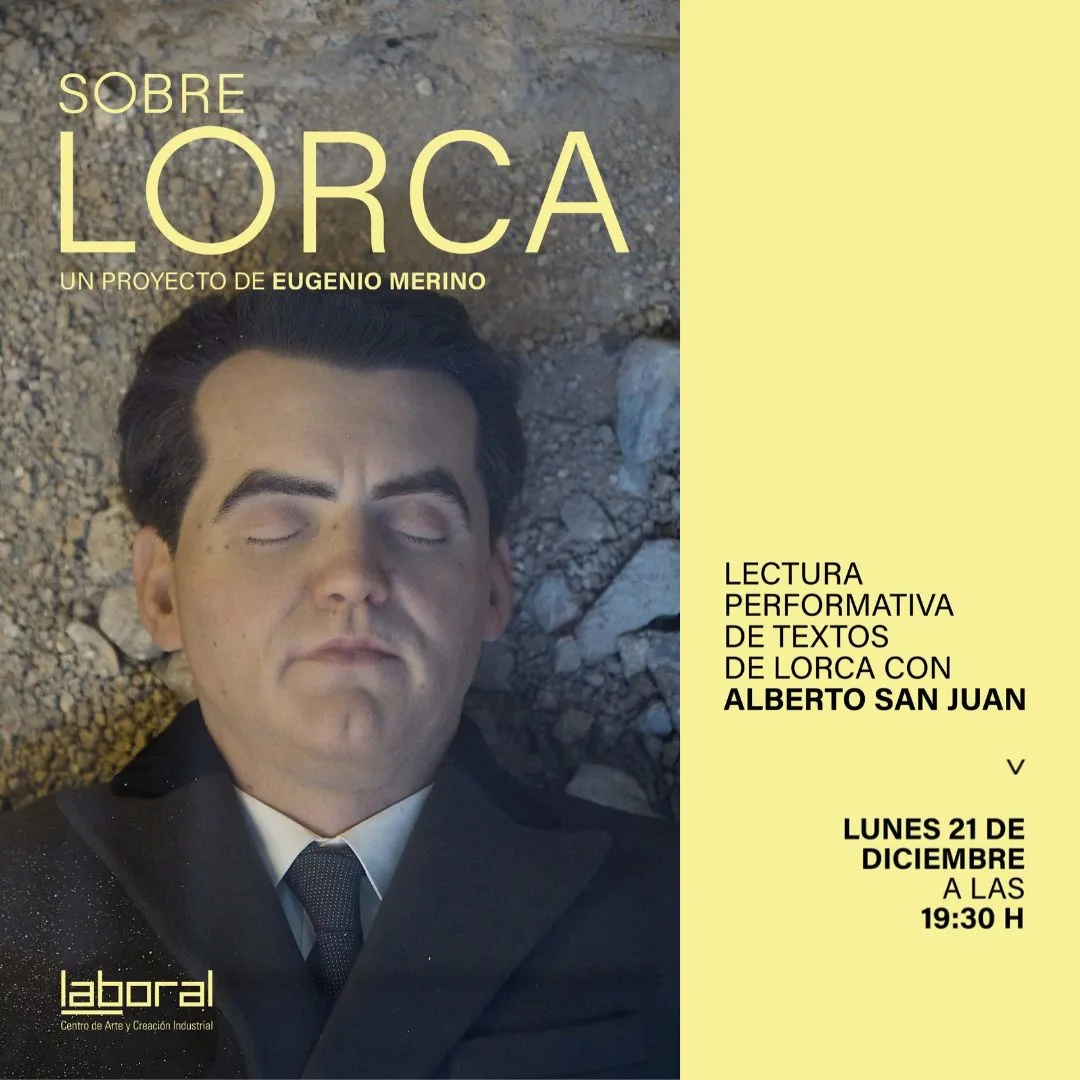
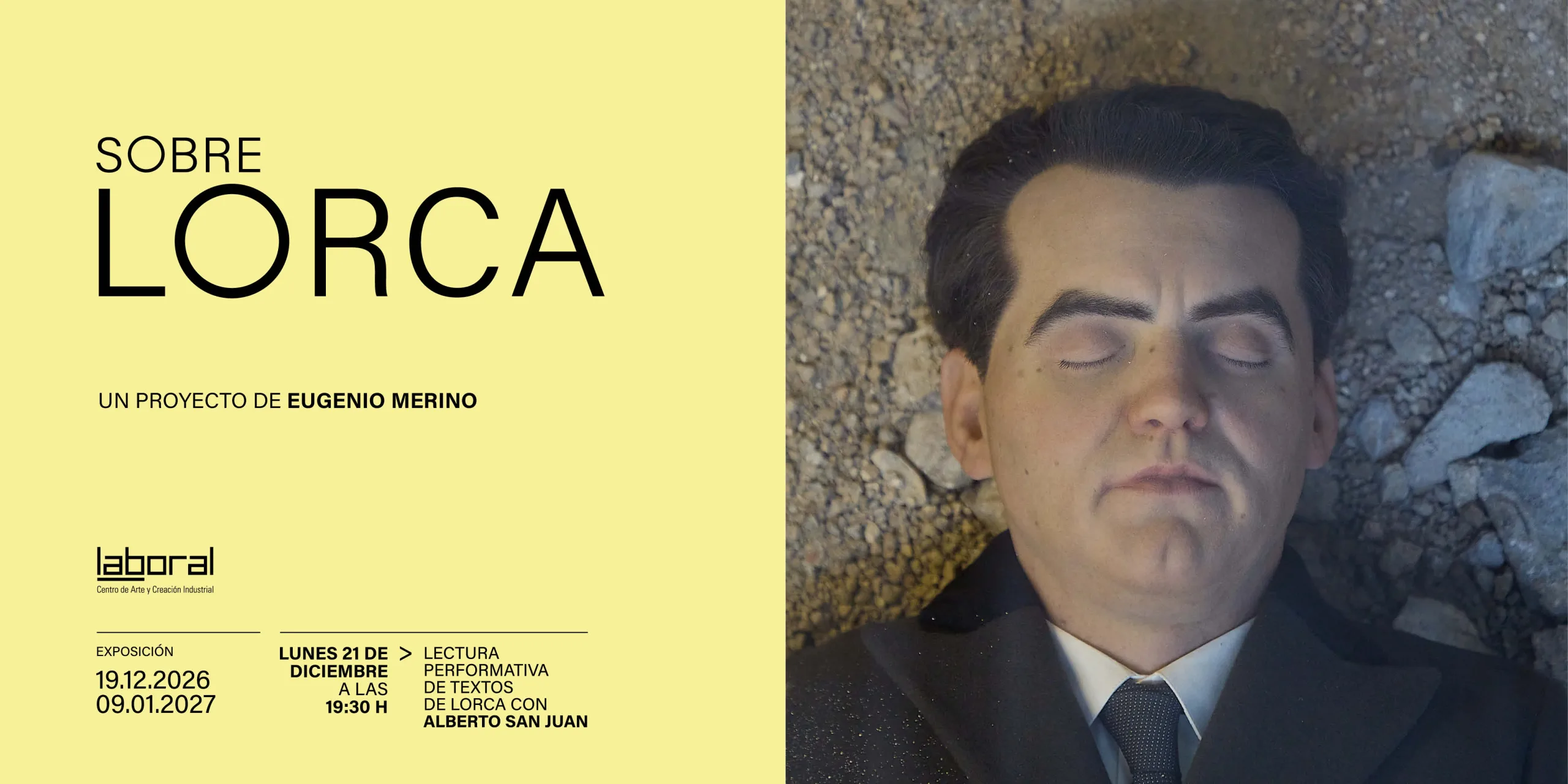
Sobre Lorca is an installation by the artist Eugenio Merino, centred on the recumbent body of Federico García Lorca. Standing over him, and for the course of a day, Alberto San Juan performed the act of reading the poet’s political texts, in an attempt to restore his voice through his words and thoughts.
The sculptural installation, which was originally presented in Carabanchel in the form of an open crack in the ground, has, from the outset, sought to ‘make us look down’. Beneath a walkable glass panel, the hyper-realistic body of Federico García Lorca appears in a pit that evokes both his disappearance and that of thousands of victims of repression who remain beneath our feet. The work unflinchingly reveals the uncomfortable reality that these absences continue to form part of our present-day history.
For months now, the piece has been on display at the Arkhé Archive in Madrid, where it shares a space dedicated to research and remembrance with other works from an archive committed to preserving and highlighting dissident and queer memories, thereby broadening the scope of this work to also serve as a piece that reflects on violence, exclusion and resistance. From the outset, Merino was clear about the social and collective dimension of the work, which did not end with its exhibition; rather, on the contrary, it came to life every time Lorca and the thousands of people who suffered reprisals during the dictatorship for their political stances and their choice were remembered.
In this new production, once again narrated by Alberto San Juan, the play returns to a question that continues to challenge us: Lorca remains Spain’s most famous missing person, but he is also an allegory for the thousands of bodies that lie unidentified in mass graves. The power of Sobre Lorca lies precisely in its ability to transform absence into presence and silence into awareness. For, as this play teaches us, memory is not a finished exercise, but, above all, a living practice that needs to be constantly re-engaged in order to question our present as a society.