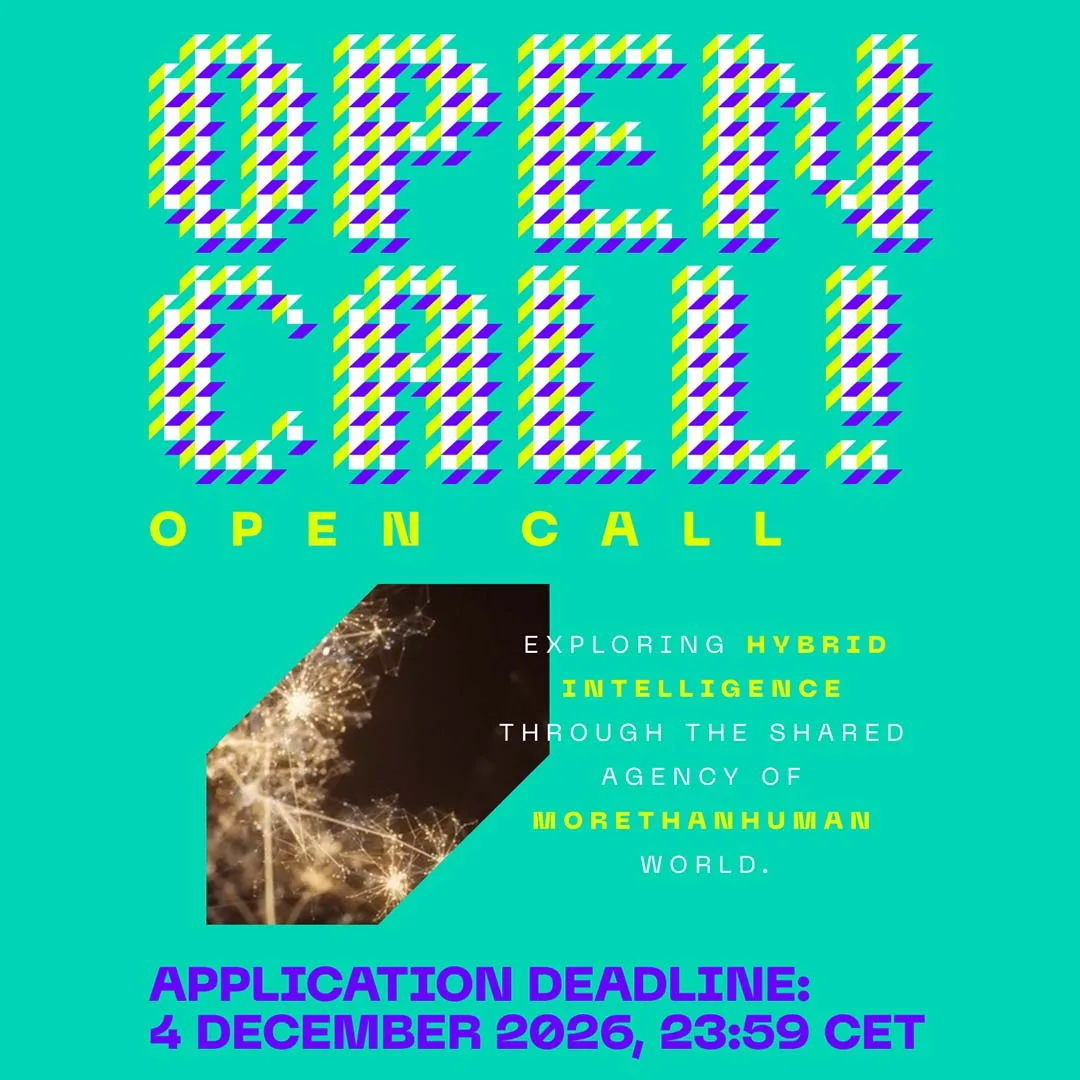
LABoral Centre for Art and Industrial Creation invites artists to undertake one of the six residencies organised by the European Hybrid Intelligence Network (EHIN) at its premises. This is the first call for applications launched by this network, which comprises six European institutions and is co-funded by Creative Europe. The EHIN project explores hybrid intelligence arising from non-human living systems.
Purpose of the call for applications
This call for applications is aimed at artists and artistic collectives interested in exploring intelligence and computing beyond conventional models centred on the human and the mechanical.
Each applicant may apply to only one of the six host institutions:
- Kersnikova, Slovenia
- Centre for the Promotion of Science, Serbia
- Gluon, Belgium
- LABoral Centre for Art and Industrial Creation, Spain
- Zentrum für Kunst und Medientechnologie (ZKM), Germany
- Kontejner, Croatia.
With the aim of exploring how non-human living systems – plants, fungi, microorganisms and animals – process information and respond to their environment, you should choose the institution whose local context is most relevant to your proposal.
What does it offer?
During the residency, which lasts for almost twelve months, the selected artist will have priority access to LABoral’s facilities, contact with specialist networks, and curatorial and production support.
They will receive up to 25,000€ to cover their fees and production costs, and LABoral will provide accommodation and cover travel expenses in accordance with the limits set by the European Union.
Furthermore, during this period, the resident will undertake a trip to one of the other venues in the EHIN network to complete the production using the resources of the selected venue. There, they will hold the second Open Dirty Lab* session and may explore the possibility of an additional co-production budget.
Open Dirty Lab*
What distinguishes a ‘dirty’ laboratory from a traditional, sterile one? Under the Open Dirty Lab concept, EHIN proposes creating spaces for collaborative work between artist-in-residence, scientists and local professionals within the very environment where the interdependencies of living systems – the subject of the residency’s research – occur. These laboratories will take the form of mobile research kits, modular stations or small permaculture incubators. In this way, scientific research moves beyond its traditional confines to blend with artistic practice and imagination.
Timetable
Between February 2027 and January 2028, the selected artists will develop a work of art to be exhibited at the host institution and, subsequently, in the group exhibition featuring all the residencies, to be held at the ZKM (Germany).
They will also document this artistic process and share it with the public through two sessions of activities known as Open Dirty Lab.
Applications
Applications must be submitted exclusively online via this form, in accordance with the guidelines set out in the Guide for Applicants. Applicants must be residents of the European Union or tax residents in an EU Member State, or in one of the eligible non-EU countries.
Deadline: 4 December 2026, at 23:59.
For further information, please visit the EHIN website
About the European Hybrid Intelligence Network (EHIN)
Led by Kersnikova (Slovenia), EHIN brings together five other European institutions with extensive experience in projects at the intersection of art and science (Centre for the Promotion of Science, Serbia; Gluon, Belgium; LABoral Centre for Art and Industrial Creation, Spain; Zentrum für Kunst und Medietechnologie, Germany; and Kontejner, Croatia). Drawing inspiration from the relationships established between plants and other organisms – living systems – as ‘green computers’, the EHIN project explores bioinformatics as a sustainable alternative to silicon-based technologies. Through workspaces where art, science and fieldwork interact, EHIN seeks to develop technologies that help tackle the energy crisis and foster new ways of understanding biological processes.