

José María Rodríguez Gómez
2 February 2026 – 31 July 2026
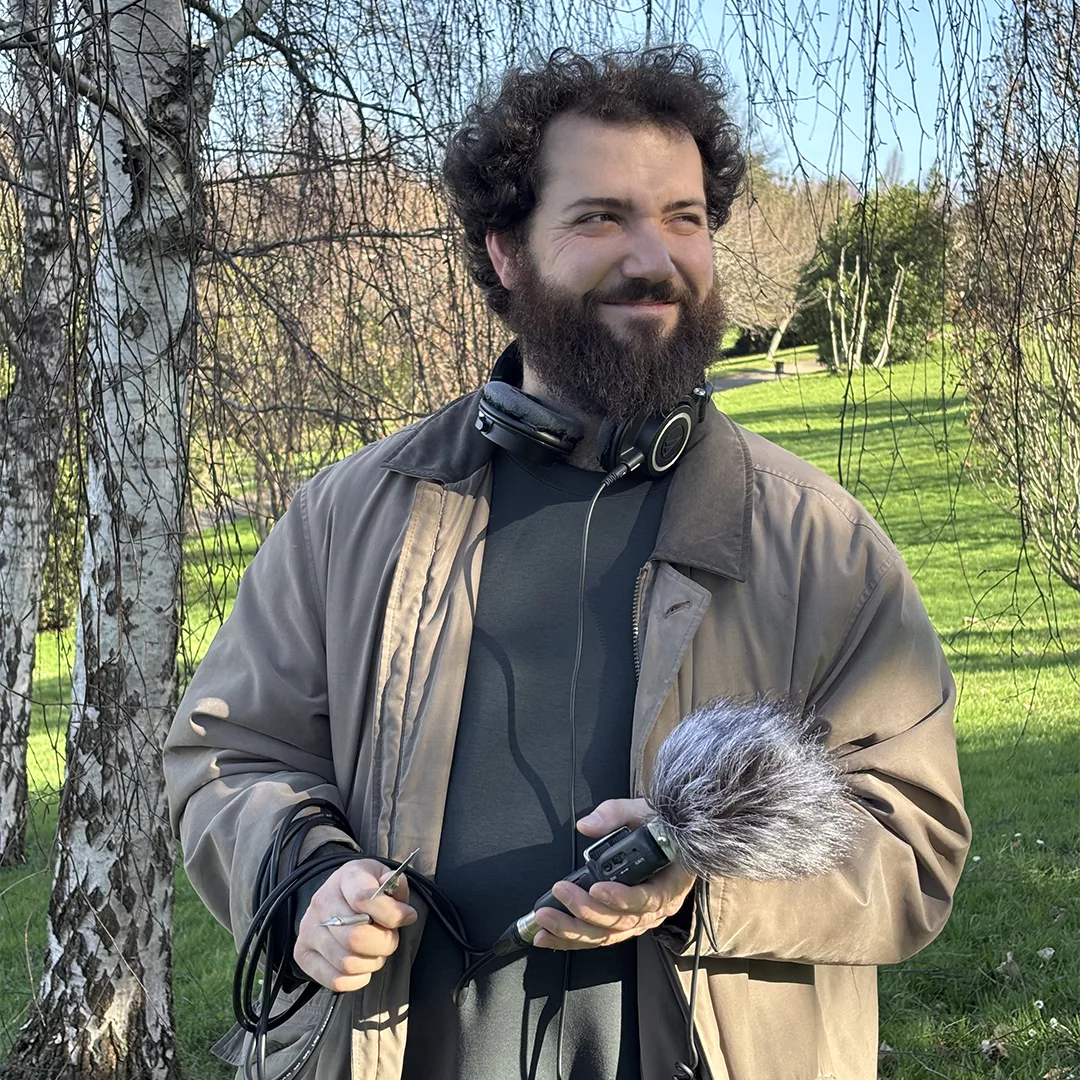
José María Rodríguez Gómez (Albacete, 1995) studied Physics at the University of Murcia and Composition at the Conservatory of Music of Castilla-La Mancha. He was a member of the Human Changes collective, dedicated to promoting electroacoustic music and sound art in Castilla-La Mancha through concerts, conferences, and installations. He has taught on the Master’s Degree in Music Research at the UNIR and Music Technology at the CONSMUPA. He is currently pursuing a PhD in Music Science and Technology at the UPM.
He uses the creative process to explore topics of interest to him, often in the scientific field. These topics, in turn, become generators of form, material and discourse for his creations. He seeks to extract the essential, beautiful or surprising and adapt it to the world of sound, without directly sonifying data, but rather creating a kind of sound simulation, seeking analogies between the underlying laws that govern both worlds. In this process, technology plays the role of mediator of interaction: between science and art; between human and work.
Project in residence
Sound like a tree
From the myth of Apollo and Daphne to The Vegetarian, the idea of transforming oneself into a tree as a way of escaping suffering has been present in the arts. This project explores it through sound, using Deep Learning tools both to transform timbre in real time and to interact with the sound environment through gesture and movement.
What does a tree sound like? The sound of foliage swaying in the wind, or the crunch of leaves underfoot quickly come to mind. And the bark? Being such a textural element, it can be captured by dragging contact microphones across its surface. In this project, field recordings of these sounds will be used to train neural synthesis models such as DDSP or RAVE, which will later be used to hybridise live with the human voice. And the roots? Generally hidden and inaccessible, we can only imagine certain sounds based on intuition and the study of how they work. Concatenative synthesis techniques will be explored to materialise them.
In a techno-dependent and frenetic society that has forgotten its natural origins, trees, far from being decorative objects or a source of resources, retain the capacity to fascinate that once made them divine. Perhaps by putting ourselves in their shoes, we will go from looking at them with disdain to looking at them with envy.