(Avilés, 1969)
A port is, by definition, the setting for a society’s collective memory. Its docks bear witness to stories of rootedness, uprooting and the trade that builds civilisations. This tower embodied control and surveillance, the panoptic eye that brought order to the chaos of the sea. To see it today in ruins, caged by an industrial mesh, disrupts that dynamic of power: what once controlled external traffic now remains confined, unable to communicate with the world.
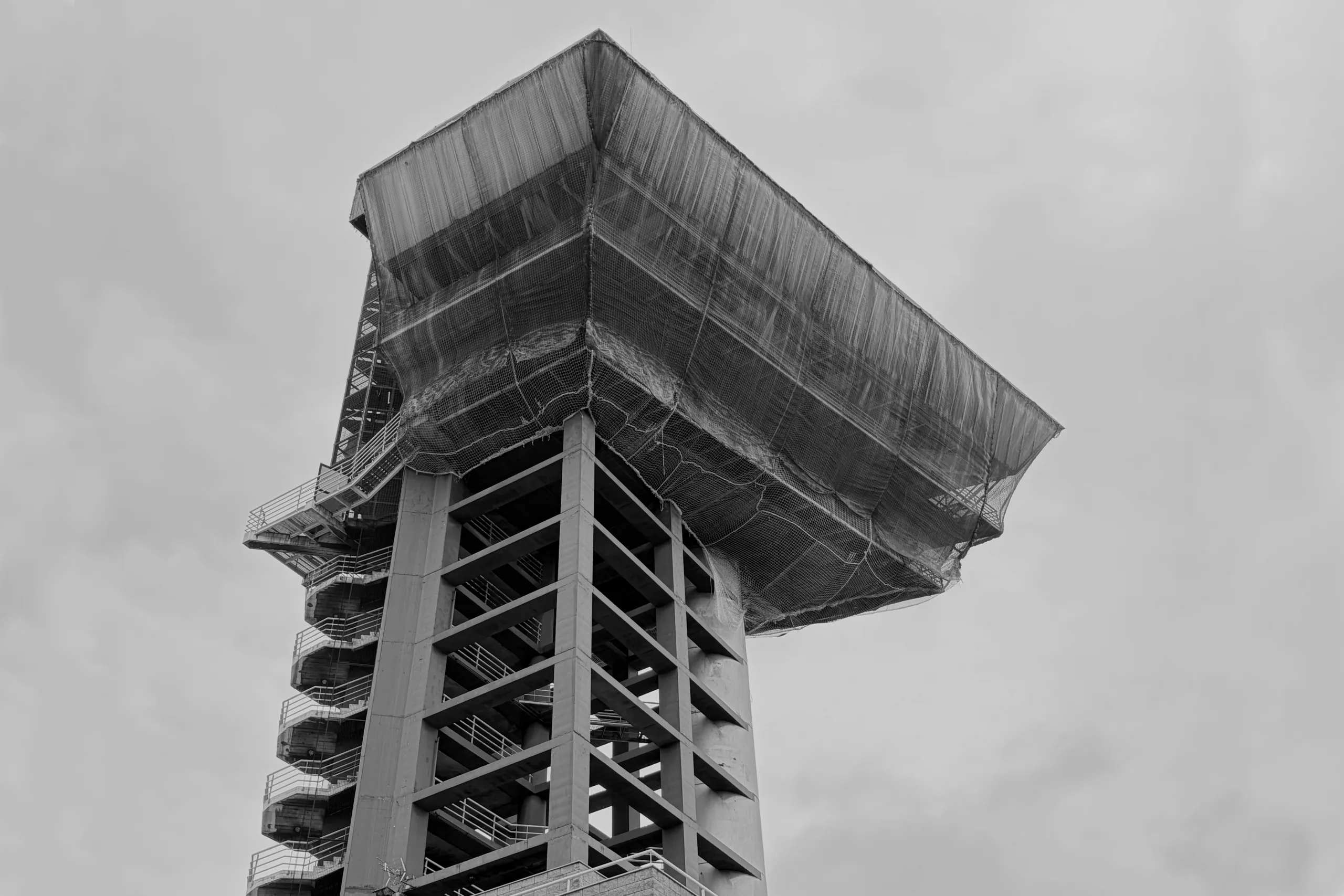
Malla negra [Black Mesh] is a reflection on the symbol of control and surveillance embodied by the port as a place. An icon that can offer only veiled glimpses through the mesh that covers it. Yet it remains present through the forcefulness and brutality of its architecture. Stripped of its primary function, it takes on a new meaning open to interpretation.
Malla negra [Black Mesh] poetically and tragically inverts Michel Foucault’s panopticon theory, as developed in his work Discipline and Punish; the eye of power has been blinded, caged and placed under physical quarantine.
In Aesthetics of Disappearance, Paul Virilio argued that Western technology and speed accelerate the obsolescence of our own material constructions. The ruined tower is the ‘accident’ or material residue left behind by modern maritime progress. ‘Speed is the old age of the world… the production of absolute speed is equivalent to the production of absolute blindness’.
A ruined control tower no longer watches over the horizon; now it is the one being watched, trapped in its own decline. This photograph captures the skeleton of what was once the nerve centre of a port, a frenetic hub where the destinies of thousands of people and the ceaseless flow of goods intersected.
Today, stripped of its guiding role, the structure survives shrouded in netting: a physical veil that serves as a metaphor for containment, oblivion and isolation.
A twilight romanticism inhabits this image. The ruin is not presented as mere rubble, but as a monument to transience. The mesh covering it not only protects the surroundings from its physical collapse, but also acts as a textile shroud that safeguards the memory of a glorious past. It is the visual boundary between what was once a driving force of human exchange and the poetic silence that devours everything humanity attempts to master.
El puerto es, por definición, el escenario de la memoria colectiva de una sociedad. En sus muelles se inscriben las historias del arraigo, del desarraigo y del comercio que construye civilizaciones. Esta torre encarnaba el control y la vigilancia, el ojo panóptico que ordenaba el caos del mar. Verla hoy en ruinas, enjaulada por una red industrial, altera esa dinámica de poder: lo que antes controlaba el tránsito exterior ahora permanece confinado, incapaz de comunicarse con el mundo.
Malla negra es una mirada al símbolo del control y vigilancia del puerto como lugar. Un icono que solo puede ofrecer miradas veladas a través de la malla que lo cubre. Pero aun así está presente por la rotundidad y brutalidad de su arquitectura. Desposeída de su función principal adquiere una nueva lectura abierta a la interpretación.
Malla negra invierte de forma poética y trágica la teoría del panóptico de Michel Foucault desarrollada en su obra Vigilar y castigar; el ojo del poder ha sido cegado, enjaulado y puesto bajo cuarentena física.
En Estética de la desaparición Paul Virilio planteaba que la tecnología y la velocidad occidentales aceleran la obsolescencia de nuestras propias construcciones materiales. La torre en ruinas es el «accidente» o residuo material que deja atrás el progreso marítimo moderno. «La velocidad es la vejez del mundo… la producción de una velocidad absoluta equivale a la producción de una ceguera absoluta».
Una torre de control en ruinas ya no vigila el horizonte; ahora es ella la que es observada, atrapada en su propio declive. Esta fotografía captura el esqueleto de lo que alguna vez fue el cerebro de un puerto, un nodo frenético donde se cruzaban los destinos de miles de personas y el flujo incesante de mercancías.
Hoy, despojada de su función rectora, la estructura sobrevive envuelta en una malla: un velo físico que funciona como metáfora de la contención, el olvido y el aislamiento.
En esta imagen habita un romanticismo crepuscular. La ruina no se presenta como un simple escombro, sino como un monumento a la transitoriedad. La malla que la cubre no solo protege el entorno de su derrumbe físico, sino que actúa como una mortaja textil que resguarda la memoria de un pasado esplendoroso. Es la frontera visual entre lo que fue un motor de intercambio humano y el silencio poético que devora todo lo que el ser humano intenta dominar.
–
Carlos Suárez forma parte de la exposición Miradas al Puerto.